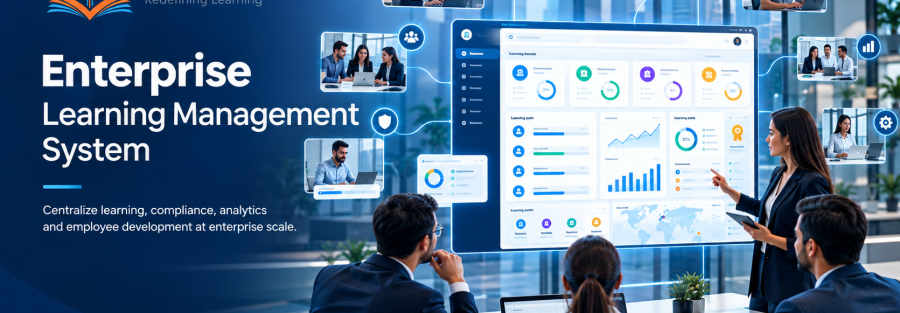
Organizations today are managing increasingly complex learning and development requirements. Employees may be distributed across departments, branches, cities, or countries, while training teams need to manage courses, assessments, compliance programs, onboarding, certifications, and performance data.
Managing these activities through spreadsheets, disconnected tools, emails, and separate learning platforms can become difficult as an organization grows.
An enterprise learning management system (LMS) provides a centralized environment for managing learning and training at organizational scale.
Unlike a basic LMS designed primarily for individual courses or small teams, an enterprise LMS is built to support complex organizational structures, large learner populations, advanced reporting, integrations, security requirements, and scalable learning programs.
In this guide, we explore what an enterprise learning management system is, its key features, benefits, implementation considerations, and how organizations can choose the right enterprise LMS platform.
What Is an Enterprise Learning Management System?
An enterprise learning management system is a centralized digital platform that enables large organizations to create, deliver, manage, track, and analyze learning and training programs across multiple teams, departments, locations, or business units.
An enterprise LMS can support different learning models, including:
- Employee onboarding
- Corporate training
- Compliance training
- Leadership development
- Technical training
- Professional development
- Certification programs
- Sales and product training
- Academic and institutional learning
- Continuous professional development
The main difference between a standard LMS and an enterprise LMS is scale, governance, integration, and organizational complexity.
An enterprise learning management system should not simply provide access to courses. It should help an organization build a structured learning ecosystem that connects learners, administrators, managers, training teams, and organizational objectives.
Why Do Large Organizations Need an Enterprise LMS?
As organizations grow, learning management becomes more complicated.
A company with hundreds or thousands of employees may have different training requirements for different departments.
For example:
- HR may manage employee onboarding.
- Compliance teams may manage mandatory training.
- Sales teams may require product training.
- Managers may need leadership development.
- IT teams may require technical certifications.
- Executives may require specialized development programs.
Managing all of these requirements manually can create operational challenges.
An enterprise LMS provides a centralized system where organizations can manage these learning activities more efficiently.
Key advantages include:
- Centralized learning management
- Scalable learner management
- Automated training workflows
- Real-time learning visibility
- Advanced reporting and analytics
- Structured learning paths
- Department-level management
- Compliance monitoring
- Integration with existing business systems
Key Features of an Enterprise Learning Management System
The right enterprise LMS should provide more than basic course delivery.
Below are some of the most important capabilities organizations should consider.
1. Centralized Learning Management
A centralized LMS allows organizations to manage courses, learners, training programs, assessments, and learning data from one platform.
Instead of maintaining separate systems for different departments or locations, administrators can manage learning activities through a unified environment.
This creates greater consistency and visibility across the organization.
2. Multi-Department and Multi-Location Management
Large organizations often operate across multiple departments, branches, campuses, or geographic regions.
An enterprise LMS should therefore support organizational structures such as:
- Departments
- Branches
- Business units
- Campuses
- Regional teams
- Employee groups
- Manager hierarchies
This allows organizations to maintain centralized control while giving different teams appropriate visibility and access.
LearnTech’s EWS LMS, for example, is designed for multi-department, multi-campus, and multi-branch environments with centralized control and role-based visibility.
3. Role-Based Access Control
Not every user should have access to the same information.
An enterprise LMS can use role-based access control to define what different users can see and manage.
For example:
Administrator
Can manage the overall LMS.
Training Manager
Can manage training programs and learner performance.
Department Manager
Can monitor their team’s learning activity.
Employee
Can access assigned courses and training.
This structure helps organizations maintain better governance and data control.
4. Employee Training and Onboarding
One of the most common applications of an enterprise LMS is employee training.
Organizations can create structured learning journeys for new and existing employees.
For example:
New Employee
→ Company Orientation
→ Policies & Compliance
→ Department Training
→ Role-Specific Training
→ Assessment
→ Certification
This creates a repeatable onboarding process instead of relying on manually coordinated training.
An LMS can also help organizations track whether employees have completed required training.
5. Learning Paths and Structured Programs
Enterprise learning often requires employees to complete training in a particular sequence.
A learning path can define the required progression.
For example:
Leadership Development Program
- Leadership Fundamentals
- Communication Skills
- Decision Making
- Team Management
- Performance Management
- Final Assessment
This creates a structured learning experience instead of simply giving employees access to a large library of courses.
6. Learning Analytics and Reporting
One of the biggest advantages of an enterprise LMS is the ability to turn learning activity into measurable data.
Organizations can monitor metrics such as:
- Course completion
- Assessment performance
- Learner progress
- Training participation
- Certification status
- Department performance
- Compliance completion
- Learning activity
This allows L&D and management teams to understand how their learning programs are performing.
Instead of asking:
“Did we provide the training?”
organizations can begin asking:
“What happened after the training?”
That shift from training delivery to measurable learning outcomes is increasingly important for modern organizations.
7. Compliance Training
Many industries require employees to complete mandatory training.
Examples include:
- Workplace safety
- Regulatory compliance
- Information security
- Data privacy
- Financial compliance
- Healthcare procedures
- Industry-specific policies
An enterprise LMS can help organizations assign mandatory courses, monitor completion, generate reports, and identify employees who have not completed required training.
This makes compliance management more structured and measurable.
8. Assessments and Certifications
Training programs often need a way to verify learner knowledge.
Enterprise LMS platforms can support:
- Quizzes
- Exams
- Assessments
- Question banks
- Passing criteria
- Certificates
- Completion records
- Performance reports
Organizations can use these capabilities to evaluate whether employees have achieved the required level of knowledge or competency.
For more advanced assessment requirements, enterprise learning ecosystems can also integrate dedicated assessment and proctoring capabilities. LearnTech’s assessment solution supports question banks, competency analysis, reporting, and enterprise-scale assessments.
9. Integration With Existing Business Systems
An enterprise LMS rarely operates in isolation.
Large organizations may already have systems such as:
- HRMS
- ERP
- Student Information Systems
- CRM
- Identity management systems
- Attendance systems
An enterprise LMS should therefore support integration through APIs or other appropriate technologies.
Common integration requirements can include:
Employee synchronization
Automatically synchronize employee information.
Course enrollment
Automatically enroll employees into relevant programs.
Training records
Transfer completion and certification data.
Single Sign-On
Allow users to access the LMS through existing organizational authentication.
LearnTech’s EWS LMS supports API-based integration with ERP, HRMS, and Student Information Systems, along with SSO capabilities.
10. Enterprise Security and Access Control
Security becomes increasingly important as the number of users and the sensitivity of learning data increases.
Organizations should evaluate an enterprise LMS based on areas such as:
- Role-based access
- Authentication
- User permissions
- Data privacy
- Secure sessions
- Department-level visibility
- Hosting architecture
- Backup and recovery
- Administrative controls
Organizations in regulated industries may also have additional security and compliance requirements.
Therefore, security should be evaluated during LMS selection rather than treated as an afterthought.
Enterprise LMS vs. Basic LMS
A basic LMS may be sufficient for a small training program.
However, enterprise environments usually require greater organizational control.
| Capability | Basic LMS | Enterprise LMS |
|---|---|---|
| Course Management | ✓ | ✓ |
| Learner Management | ✓ | ✓ |
| Large User Volumes | Limited | ✓ |
| Multi-Department | Limited | ✓ |
| Multi-Location | Limited | ✓ |
| Advanced Reporting | Basic | Advanced |
| Role-Based Access | Basic | Advanced |
| Enterprise Integrations | Limited | ✓ |
| SSO | Sometimes | ✓ |
| Compliance Management | Basic | Advanced |
| Organizational Hierarchy | Limited | ✓ |
| Scalable Infrastructure | Limited | ✓ |
The right choice depends on the organization’s size, learning requirements, technical environment, and long-term growth plans.
How to Choose the Right Enterprise Learning Management System
Choosing an enterprise LMS should not be based simply on the number of features listed on a vendor’s website.
Organizations should evaluate the platform against their actual requirements.
1. Define Your Learning Objectives
First determine what the LMS needs to accomplish.
Are you looking to manage:
- Employee onboarding?
- Corporate training?
- Compliance?
- Professional development?
- Certification?
- Academic programs?
- Leadership development?
Your objectives should guide the platform selection.
2. Evaluate Scalability
Consider the organization’s current and future learner population.
An LMS that works for 500 users may not necessarily be the right solution for an organization expecting to manage several thousand learners across multiple locations.
Scalability should therefore be evaluated before implementation.
3. Check Integration Requirements
Identify which systems the LMS needs to communicate with.
For example:
HRMS → LMS
Employee data synchronization.
LMS → HRMS
Training completion records.
ERP → LMS
Organizational or user information.
SSO → LMS
Centralized authentication.
Understanding these requirements early can reduce implementation challenges later.
4. Evaluate Analytics and Reporting
Ask whether the platform can provide the level of reporting required by your organization.
For example:
- Executive dashboards
- Department reports
- Learner reports
- Compliance reports
- Assessment reports
- Completion reports
- Certification reports
Good reporting should help management make decisions, not simply provide large amounts of data.
5. Consider Customization
Every organization has different processes.
Some organizations may need customized workflows, dashboards, integrations, branding, permissions, or learning structures.
A flexible enterprise LMS can adapt to organizational requirements instead of forcing the organization to completely change its existing processes.
Enterprise LMS Implementation: What Organizations Should Plan
Selecting the platform is only the first step.
A successful enterprise LMS implementation should consider:
Phase 1 — Requirements
Identify users, departments, learning objectives, integrations, reporting requirements, and security needs.
Phase 2 — Platform Configuration
Configure organizational structures, roles, permissions, courses, learning paths, and workflows.
Phase 3 — Content Migration
Move existing courses, training materials, assessments, and learner data where required.
Phase 4 — Integration
Connect the LMS with HRMS, ERP, SSO, or other organizational systems.
Phase 5 — Testing
Test workflows, permissions, integrations, reporting, assessments, and user experience.
Phase 6 — Launch
Roll out the LMS to the organization.
Phase 7 — Optimization
Use learning analytics and user feedback to continuously improve the learning ecosystem.
Enterprise Learning Management System for Modern Organizations
The role of an LMS is changing.
Organizations no longer need a system that simply stores courses.
Modern enterprise learning environments need to connect:
People + Learning + Technology + Data + Business Objectives
An effective enterprise learning management system can provide the infrastructure needed to manage this ecosystem.
For large organizations, the goal should not simply be to deploy an LMS.
The goal should be to create a scalable learning environment that improves employee capability, provides measurable insights, supports compliance, and aligns learning with organizational performance.
Why LearnTech Global for Enterprise LMS?
LearnTech Global provides enterprise learning technology solutions designed for organizations that require scalable learning infrastructure.
Its EWS LMS is designed to support corporate organizations, universities, schools, banking and financial services, aviation and logistics, oil and energy, retail, manufacturing, healthcare, and government environments.
The platform supports capabilities including:
- Structured learning delivery
- Learner and role management
- Advanced reporting and analytics
- Multi-department environments
- Multi-campus and multi-branch deployments
- SSO
- ERP and API integrations
- WhatsApp learning notifications
- Enterprise security controls
- Scalable deployment options
LearnTech Global’s broader ecosystem also includes custom eLearning development, online assessment and proctoring, learning analytics, and other digital learning solutions.
Final Thoughts
An enterprise learning management system is more than an online course platform.
For organizations managing large workforces, multiple departments, compliance requirements, distributed teams, and complex learning programs, an enterprise LMS can provide a centralized infrastructure for managing learning at scale.
The right platform should provide the combination of:
Scalability + Security + Integration + Analytics + Learning Management + Organizational Control
Before selecting an LMS, organizations should evaluate their current requirements as well as their future learning strategy.
A well-designed enterprise LMS can become an important part of an organization’s broader digital learning and workforce development ecosystem.
Ready to build a scalable enterprise learning environment?
Explore LearnTech Global’s EWS LMS or request a consultation to discuss your organization’s learning requirements.