
LMS vs LXP: Key Differences and How to Choose the Right Learning Platform
Learning Management Systems (LMS) and Learning Experience Platforms (LXP) are often discussed as competing technologies. In practice, they solve different learning problems.
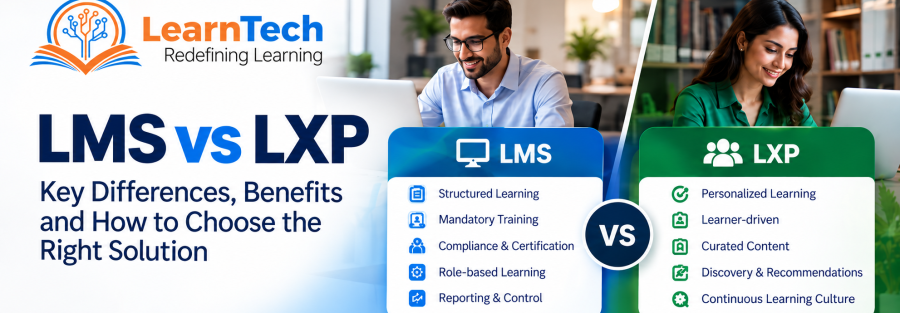
An LMS is typically designed to manage structured, assigned, and measurable learning. An LXP places greater emphasis on learner choice, content discovery, personalization, and continuous learning. For many organizations, the decision is not simply “LMS or LXP?” but rather “What learning model are we trying to support?”
What Is an LMS?
A Learning Management System is a platform for administering, delivering, tracking, and reporting structured learning. It is commonly used for onboarding, compliance, certification, formal development programs, academic learning, and other activities where organizations need clear learning paths and reliable records.
Typical LMS capabilities include course management, enrollment, assessments, certifications, user and role management, completion tracking, reporting, administration, and integrations.
What Is an LXP?
A Learning Experience Platform is designed around the learner experience. LXPs typically help people discover learning resources from multiple sources, receive personalized recommendations, follow interests or skill areas, and participate in social or collaborative learning.
Typical LXP capabilities can include content aggregation, recommendation engines, personalized feeds, skill-based discovery, user-generated content, communities, and social learning.
LMS vs LXP: Key Differences
|
Area |
LMS |
LXP |
|
Primary focus |
Management, structure, tracking |
Experience, discovery, personalization |
|
Learning model |
Often assigned and administrator-led |
Often self-directed and learner-led |
|
Best suited to |
Compliance, onboarding, certification, formal programs |
Continuous learning, exploration, upskilling, knowledge sharing |
|
Content |
Approved courses and structured programs |
Aggregated and curated resources from multiple sources |
|
Administration |
Strong governance and control |
Greater learner autonomy |
|
Reporting |
Completions, assessments, compliance, formal records |
Engagement, interests, recommendations, learning behavior |
|
Personalization |
Role- or rule-based learning paths |
Often recommendation-driven and dynamic |
|
Social learning |
Available in some LMS platforms |
Usually a stronger design emphasis |
When an LMS Is the Better Fit
- You must assign mandatory training and prove completion.
- Certification, assessment, or audit-ready records are important.
- Learning needs to follow defined curricula or role-based pathways.
- Managers and administrators require structured reporting.
- You need formal governance across departments, branches, or learner groups.
- Integrations with HR, identity, ERP, SIS, or compliance processes are important.
When an LXP Adds More Value
- Learners need freedom to explore content beyond assigned courses.
- The organization wants to strengthen continuous learning and knowledge sharing.
- Personalized recommendations are a core requirement.
- Learning resources come from many internal and external sources.
- The learning strategy emphasizes skills discovery, communities, peer learning, or self-directed development.
Do Organizations Need Both?
Many organizations have both structured and self-directed learning needs. Compliance may require an LMS, while continuous development may benefit from LXP-style discovery and personalization. In that situation, the two approaches can complement each other.
However, buying two platforms is not automatically the right answer. Before adding an LXP, organizations should check whether their existing LMS already supports learning paths, content libraries, recommendations, social learning, gamification, microlearning, or other experience-focused features. Modern LMS environments increasingly include capabilities that once sat mainly in the LXP category.
Five Questions to Ask Before Choosing
- What learning must be mandatory, tracked, certified, or audited?
- How much learner choice and content discovery do we want to encourage?
- Do we already have an LMS, and what experience-related capabilities can it provide?
- Where will content come from — internal courses, external libraries, videos, articles, experts, or user-generated knowledge?
- What data do we need to manage: formal learning records, skill signals, engagement behavior, or all of these?
A Practical Example
Consider a bank or other regulated organization. Mandatory compliance, information security, onboarding, and certification training require clear assignment, deadlines, assessments, and evidence — an LMS-style requirement. Leadership development and continuous professional learning, however, may benefit from curated content, short videos, peer discussion, and self-directed learning — an LXP-style experience.
The organization does not necessarily need to choose one philosophy for every learning need. It needs an architecture that supports both control and engagement where appropriate.
Where LearnTech Global Fits
LearnTech Global’s EWS LMS is designed around structured enterprise learning, governance, reporting, integrations, and scalable administration. The environment can be extended with microlearning, content libraries, gamification, analytics, virtual learning, custom eLearning, and other experience-focused components.
For organizations comparing LMS and LXP approaches, the first step should therefore be to define the learning model. Once the desired balance between formal learning and learner-driven development is clear, the platform architecture becomes easier to determine.
Final Thoughts
LMS and LXP are not simply old versus new technologies. They reflect different priorities. An LMS provides structure, control, records, and accountability. An LXP emphasizes discovery, personalization, and continuous learning.
The right choice depends on your business requirements, learning culture, compliance needs, content strategy, and existing technology environment. In some cases the answer is an LMS. In others it is an LXP. And for many organizations, the best design combines elements of both.
Talk to LearnTech Global about your learning platform requirements, or explore EWS LMS and the wider digital learning ecosystem.