
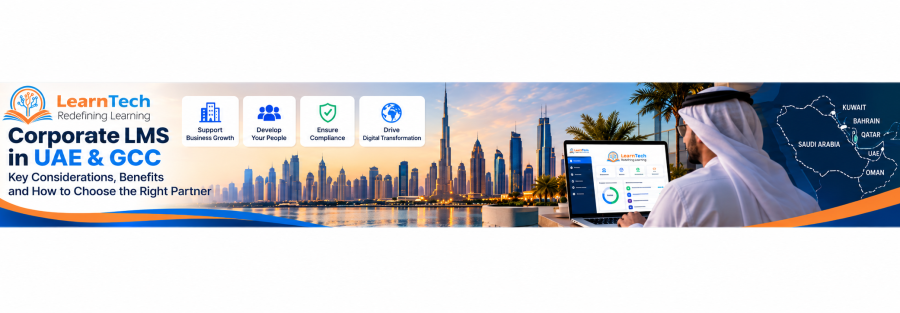
Corporate LMS in UAE & GCC: What Businesses Should Look for in 2026
Organizations across the UAE and wider GCC are investing in digital learning to support onboarding, compliance, workforce development, certification, leadership, customer training, and continuous professional development. But selecting a corporate LMS for the region requires more than comparing course features.
Businesses often operate across multiple locations, employ diverse workforces, manage sector-specific compliance requirements, and rely on enterprise systems that the LMS may need to integrate with. The right platform should therefore combine learning capability with governance, scalability, security, reporting, and operational support.
What Is a Corporate LMS?
A corporate Learning Management System is a platform used to manage employee and organizational learning. It allows businesses to deliver learning, assign programs, track progress, conduct assessments, manage certifications, and generate reports from a centralized environment.
Typical corporate use cases include employee onboarding, regulatory training, product and sales enablement, health and safety, leadership development, technical training, customer service, professional certification, and role-based upskilling.
Why UAE and GCC Organizations Need a Scalable Learning Platform
Many organizations in the region operate across branches, business units, countries, or workforce categories. A learning platform must therefore support both centralized governance and controlled local administration.
For example, group-level L&D may define mandatory learning and reporting standards, while individual companies or departments manage their own learners and programs. The LMS should make these structures manageable without creating separate systems for every team.
Key Requirements for a Corporate LMS in the UAE & GCC
1. Multi-Entity and Multi-Location Management
Organizations with multiple companies, branches, sites, or departments should be able to organize learners and reporting according to their operating structure. Role-based administration is especially important where local managers need visibility without access to the entire organization.
2. Compliance, Certification, and Auditability
Regulated sectors and large employers often need evidence that required learning has been assigned, completed, assessed, and renewed. The LMS should support deadlines, reminders, certification, completion records, and reporting that can be used for internal governance or external audit requirements.
3. Multilingual and Diverse Workforce Learning
The GCC workforce is highly diverse. Organizations should consider whether the LMS interface, learning content, notifications, assessments, and support processes can accommodate the languages and accessibility needs of their actual learner population. Localization should be planned as part of the content and experience strategy, not treated as an afterthought.
4. Mobile-Friendly and Flexible Access
Employees may work in offices, branches, retail locations, warehouses, airports, field operations, or remote environments. Browser-based and mobile-friendly access can make training easier to reach across different working contexts, subject to the organization’s security policies.
5. Integration with Enterprise Systems
SSO, HRMS, ERP, directory services, APIs, and communication tools can reduce duplicate administration and create a smoother learner journey. Integration requirements should be mapped early because they can significantly affect implementation scope and timeline.
6. Reporting for Managers and Leadership
Regional and multi-entity organizations need more than course-completion reports. Useful reporting should allow authorized stakeholders to view learning by company, department, location, program, role, or other business dimensions while protecting data appropriately.
7. Hosting, Security, and Data Requirements
Organizations should define their information-security, hosting, backup, recovery, access-control, and data-location requirements before selecting a platform. These requirements can vary by sector, internal policy, and jurisdiction, so the LMS deployment model should be evaluated against the organization’s own legal and security obligations.
8. Local and Regional Support
Technology issues, administrator questions, configuration changes, and learner support continue after launch. Businesses should therefore assess support hours, escalation processes, service levels, implementation capability, and whether the provider can work effectively with stakeholders in the region.
Corporate LMS Use Cases Across the GCC
- Banking and financial-services compliance and professional development.
- Aviation, logistics, and operational training.
- Retail and hospitality onboarding across multiple locations.
- Healthcare and regulated workforce learning.
- Energy, manufacturing, and health-and-safety programs.
- Government and public-sector capability development.
- Professional services, leadership, and continuous development.
- Partner, customer, franchise, and distributor learning.
SaaS, Private Cloud, or Dedicated Deployment?
The best deployment model depends on the organization’s IT strategy, security requirements, desired level of control, user scale, integration needs, and support model.
|
Model |
Potential Advantages |
Questions to Consider |
|
SaaS |
Faster deployment, managed environment, predictable operations |
Data requirements, configuration flexibility, integration scope |
|
Managed private cloud |
Greater isolation and control with managed operations |
Hosting location, cost, capacity planning, responsibilities |
|
Dedicated environment |
High control and customization potential |
Infrastructure ownership, administration effort, upgrades, support model |
How to Evaluate Vendors
- Start with use cases and business requirements rather than requesting a generic feature demonstration.
- Ask the vendor to demonstrate your actual workflows: onboarding, compliance, manager reporting, certification, multi-entity administration, or integrations.
- Clarify what is standard, what requires configuration, and what requires custom development.
- Review implementation methodology, data migration, administrator training, testing, support, and post-launch governance.
- Confirm security, hosting, backup, service-level, and contractual requirements with your IT, legal, and procurement teams.
- Assess whether the provider can support future growth across additional departments, countries, or learning programs.
LearnTech Global in the UAE & GCC
LearnTech Global expanded its international presence through LearnTech FZCO in Dubai, supporting organizations in the UAE and wider GCC alongside our learning-technology delivery teams.
Our EWS LMS supports enterprise and institutional learning requirements including structured learning delivery, reporting and analytics, user and hierarchy management, SSO, API-based integrations, WhatsApp notifications, assessments, flexible deployment, and managed support. Organizations can also extend the platform with custom eLearning, microlearning, online assessment and proctoring, content libraries, and learning analytics.
This allows regional clients to work with LearnTech on the broader learning ecosystem — not only on the LMS software itself.
Final Thoughts
A corporate LMS for the UAE and GCC should reflect the realities of the organization: workforce diversity, multiple entities or locations, compliance expectations, enterprise integrations, security requirements, and the need for reliable regional support.
The most effective selection process begins by defining those requirements clearly. Once the operating model is understood, businesses can evaluate platforms on fit, scalability, and long-term value rather than on feature quantity alone.
If your organization is evaluating a corporate or enterprise LMS in the UAE or GCC, Contact LearnTech Global for a consultation or EWS LMS demonstration.







3 Comments
Joe40
For organizations operating across multiple branches or GCC markets, a scalable learning infrastructure is essential. This article highlights the right factors to consider before implementing a corporate LMS
Caden1666
A valuable perspective for UAE organizations managing diverse, distributed, and multilingual workforces. The focus on scalability, compliance, and centralized learning is particularly relevant.
Fred206
Thanks for sharing helpful post