Organizations often begin digital learning by solving one immediate need: launching an Learning Management Solutions LMS, converting classroom material into eLearning, purchasing a content library, or introducing online assessments. Each decision may work well on its own, but over time a new problem can appear — too many disconnected learning tools.
A modern learning environment is more effective when platforms, content, assessments, analytics, communications, and business systems work together. This is the difference between buying individual learning technologies and building a digital learning ecosystem.
What Is a Learning Management Solutions?
A learning management solution is broader than a single LMS product. It combines the technology, content, processes, integrations, governance, support, and data required to deliver learning effectively across an organization.
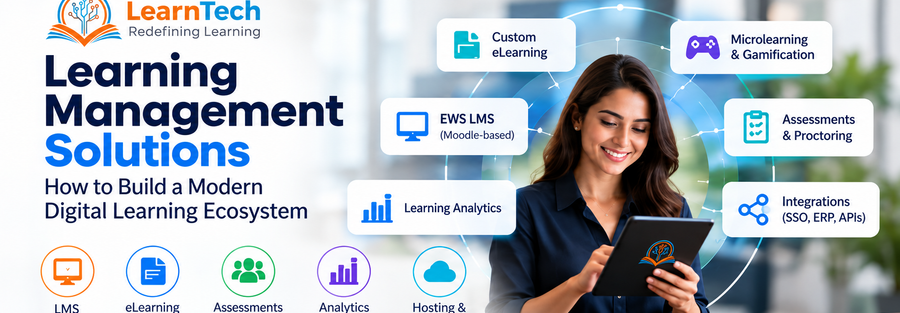
The LMS may sit at the center, but it is only one layer. A complete solution can include custom eLearning, microlearning, live virtual learning, assessment and proctoring, content libraries, analytics, identity management, enterprise integrations, communication channels, hosting, and managed support.
Why a Digital Learning Ecosystem Matters
When learning technologies are selected independently, employees may need multiple logins, administrators may duplicate data, reporting may remain fragmented, and learning records may sit in different systems. A connected ecosystem aims to reduce that fragmentation.
The goal is not to add more technology. The goal is to create a coherent environment in which learners can access the right learning, administrators can manage it efficiently, managers can see progress, and the organization can measure impact.
The Core Layers of a Modern Learning Ecosystem
1. Learning Platform
The LMS provides the operational foundation: user management, enrollment, course delivery, learning paths, assessments, certifications, reports, roles, permissions, and learning records.
2. Learning Content
A strong ecosystem combines different content formats according to the learning need. These may include interactive SCORM modules, videos, microlearning, documents, instructor-led resources, simulations, external libraries, and job aids.
3. Assessment and Evidence
Learning should not stop at content consumption. Assessments, assignments, quizzes, certification, proctoring, and practical evidence can help organizations understand whether knowledge has been acquired and whether required standards have been met.
4. Analytics and Reporting
Learning data should provide visibility at different levels: learner, course, department, location, manager, compliance function, and leadership. Reporting becomes more useful when it connects learning activity to organizational priorities rather than only showing logins and completions.
5. Integrations and Identity
SSO, HRMS, ERP, Student Information Systems, APIs, and directory services can reduce manual administration and keep learner data aligned with the organization’s existing technology environment.
6. Communication and Engagement
Email, automated reminders, WhatsApp notifications, virtual classrooms, gamification, and learner-facing communication can improve participation when used intentionally. Engagement features should support the learning journey, not simply add noise.
7. Infrastructure and Support
Hosting, backups, monitoring, upgrades, security, performance, user support, and technical administration are often invisible to learners, but they determine whether the learning environment is reliable and sustainable.
From Training Events to Continuous Learning
A connected ecosystem allows organizations to move beyond one-time training events. For example, a compliance journey might begin with an interactive module, continue with a knowledge check, trigger reminders for incomplete learners, provide managers with dashboards, and schedule refresher microlearning later in the year.
Similarly, a leadership program could combine self-paced content, live sessions, reflective activities, manager feedback, peer learning, and analytics — all within one coordinated environment.
What Organizations Should Decide Before Building the Ecosystem
- Which learning outcomes matter most to the organization?
- Which audiences will use the environment — employees, managers, customers, partners, students, or multiple groups?
- Which learning activities must be mandatory and which should be self-directed?
- What information do managers, compliance teams, and leadership need to see?
- Which systems need to exchange user or performance data?
- What content already exists and what needs to be created, converted, localized, or licensed?
- What level of internal administration can the organization manage, and what should be outsourced?
- How will success be measured after implementation?
A Practical Architecture for Digital Learning
| Layer | Typical Components | Purpose |
| Experience | Portal, mobile/browser access, notifications | Give learners a clear entry point |
| Learning | LMS, learning paths, virtual sessions | Manage structured learning |
| Content | SCORM, video, microlearning, libraries | Deliver relevant learning resources |
| Assessment | Quizzes, tests, proctoring, certification | Measure knowledge and compliance |
| Data | Dashboards, analytics, reports | Create visibility and accountability |
| Integration | SSO, HRMS/ERP/SIS, APIs | Connect learning with enterprise systems |
| Operations | Hosting, support, backups, upgrades | Keep the environment reliable and secure |
Common Mistakes to Avoid
- Buying technology before defining the learning model.
- Using separate tools without planning how data and user journeys will connect.
- Focusing heavily on content quantity while neglecting learning design and application.
- Measuring success only through course completion.
- Underestimating change management, administrator training, governance, and ongoing support.
- Customizing everything at launch instead of prioritizing the workflows that create the greatest value.
Learning Management Software vs. Manual Administration
| Area | Manual / Disconnected Approach | LMS-Based Approach |
| Learner Records | Dispersed spreadsheets, paper files | Centralized, secure digital learner profiles |
| Training Delivery | Ad-hoc emails, shared folders, physical classrooms | Structured digital, virtual, and blended delivery |
| Progress Tracking | Manual check-ins and delayed follow-ups | Real-time automated dashboards and activity logs |
| Reporting & Audits | Time-consuming data compilation | Instant, exportable audit-ready compliance reports |
| Certifications | Manually created, tracked, and renewed | Automated issuance and renewal alerts |
| Scalability | Heavy administrative overhead per new user | Scalable to thousands of learners with zero extra admin load |
How LearnTech Global Supports Connected Learning
LearnTech Global’s approach combines learning technology with content, implementation, integration, analytics, and operations. EWS LMS can provide the central learning platform, while organizations can extend the environment through custom eLearning, microlearning, assessment and proctoring, content libraries, analytics, cloud hosting, and managed support.
This modular approach allows an organization to start with the components it needs today and expand the ecosystem over time, rather than replacing the entire environment whenever requirements change.
How to Choose the Right LMS for Your Business
A successful LMS selection process starts with business objectives rather than vendor feature checklists.
[ Step 1: Define Use Cases ] ➔ [ Step 2: Map Learner Structure ] ➔ [ Step 3: Identify Integrations ]
                                                                             │
[ Step 6: Plan Long-term Scale ] 🠤 [ Step 5: Assess Implementation ] 🠤 [ Step 4: Define Reporting Needs ]-
Define Core Use Cases: Clarify whether the immediate priority is employee onboarding, mandatory compliance, leadership development, or customer education.
-
Map Learner & Organizational Structure: Outline user volumes, departments, geographic locations, and multi-entity governance requirements.
-
Identify Essential System Integrations: Determine if you require SSO, HRMS synchronization, API access, or direct WhatsApp/email alerts.
-
Clarify Reporting Requirements: Specify what metrics leadership, compliance officers, and line managers need to see regularly.
-
Assess Implementation & Ongoing Support: Look beyond software features to evaluate hosting reliability, data migration support, admin training, and technical SLAs.
-
Plan for Long-Term Growth: Choose a solution that adapts to expanding user bases, international branches, and new learning modalities without requiring a total platform migration.
When a Standard LMS Is Not Enough
Off-the-shelf, one-size-fits-all training platforms often fall short when an organization has multi-department hierarchies, complex approval workflows, bespoke branding needs, or strict data-governance standards.
In these cases, your learning platform must be treated as integrated enterprise infrastructure rather than a generic standalone app.
How LearnTech Global Approaches Learning Management
LearnTech Global partners with organizations requiring tailored, scalable learning environments. Our proprietary EWS LMS is engineered for enterprise and institutional use cases—offering multi-tier hierarchy management, deep analytics, flexible integrations, customizable notification channels, and tailored deployment models (Cloud or Private Hosting).
Furthermore, through the wider LearnTech ecosystem, organizations can complement their LMS with:
-
Custom interactive eLearning and microlearning development
-
Online assessment and remote proctoring tools
-
Advanced learning analytics and reporting
-
Dedicated hosting, cloud infrastructure, and continuous managed support
Final Thoughts
The future of digital learning is not about collecting more tools. It is about connecting the right tools around a clear learning strategy.
A successful digital learning ecosystem should make learning easier for the learner, easier to manage for administrators, more visible to managers, and more relevant to business performance. When those elements work together, learning technology becomes part of organizational capability — not just another system.
Explore LearnTech Global’s digital learning services or speak with our team about designing a connected learning ecosystem for your organization.